PA Bluestone AUCTION!

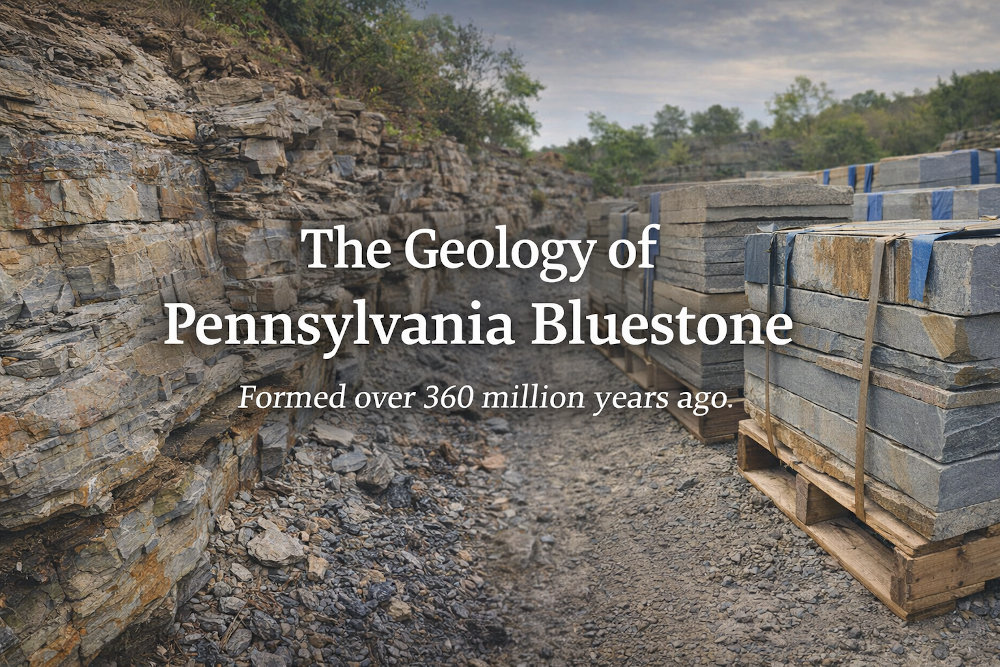
It’s very common to hear people refer to bluestone sidewalks as “slate” sidewalks. While the two stones can look similar at a glance—and do share some geological roots—they are not the same material.
This article takes a detailed look at the geology, chemistry, formation processes, and performance differences between Pennsylvania bluestone and slate, explaining why the confusion exists and why bluestone behaves so differently in the landscape.
Bluestone vs Slate
Why Bluestone and Slate Get Confused
The confusion is understandable. Both materials:
- Split naturally into flat layers
- Are used for sidewalks, patios, and roofing or paving
- Can appear blue, gray, or dark in color
- Have a long history in northeastern U.S. construction
Historically, people often used “slate” as a catch-all term for any flat, layered stone. From a geological and chemical standpoint, however, the two materials formed in very different ways.
Geologic Classification: Sedimentary vs. Metamorphic
Pennsylvania Bluestone
- Rock type: Sedimentary (sandstone)
- Age: Devonian Period (~360–380 million years old)
- Formation: River deltas, floodplains, shallow marine environments
Slate
- Rock type: Metamorphic
- Age: Originally older sedimentary mudstones/shales, later altered
- Formation: Heat and pressure during mountain-building events
Key difference: Bluestone was never subjected to the intense heat and pressure required for metamorphism. Slate was.
Original Sediments: Sand vs. Clay
Bluestone
Bluestone began as sand-dominated sediment, with quartz grains forming the bulk of the rock. This gives bluestone its strength, abrasion resistance, and durability.
Slate
Slate began as clay-rich mud. These fine clay particles realigned during metamorphism, producing slate’s characteristic cleavage.
This difference in starting material is one of the most important reasons bluestone and slate behave so differently outdoors.
Chemistry & Mineral Composition
Bluestone Chemistry
- Quartz (SiO2): dominant mineral; provides hardness and weather resistance
- Minor feldspars: accessory minerals
- Clay minerals: thin bedding layers
- Iron oxides: color variation (Fe2O3, FeO(OH))
- Carbon inclusions: darker tones
Slate Chemistry
- Quartz: present, but in finer grains
- Micas (illite, chlorite): aligned during metamorphism
- Aluminum-rich clays: dominant mineral group
- Iron sulfides (pyrite): common and problematic
From a chemistry standpoint, bluestone is silica-dominated, while slate is clay- and mica-dominated.
Why Both Split Into Flat Pieces
Bluestone: Bedding Planes
Bluestone splits along original sedimentary bedding layers, where thin clay horizons formed between sand deposits. These planes are natural but not chemically altered.
Slate: Cleavage Planes
Slate splits along metamorphic cleavage, created when clay minerals realigned under pressure. These cleavage planes are independent of original bedding.
This is a critical distinction: slate’s cleavage is a metamorphic feature, while bluestone’s splitting reflects original sediment deposition.
Color Comparison: Similar Appearance, Different Causes
Bluestone Colors
- Blue-gray from low oxidation and reduced iron
- Browns and tans from iron oxidation
- Charcoal tones from carbon-rich material
Slate Colors
- Gray and blue from fine mica alignment
- Green from chlorite
- Purples and reds from hematite
While the colors may overlap visually, the chemical drivers are different.
Weathering & Long-Term Performance
Bluestone
- Excellent freeze/thaw resistance
- Quartz framework resists chemical breakdown
- Surface patina develops slowly and evenly
Slate
- More prone to delamination outdoors
- Iron sulfides can oxidize and stain
- Cleavage planes can weaken with moisture
This explains why slate is outstanding for roofing but often less reliable for ground-level paving in harsh climates.
Why Bluestone Replaced Slate for Sidewalks
Historically, slate was used for sidewalks in some regions, but over time bluestone proved superior:
- Greater thickness availability
- Higher load-bearing capacity
- Better resistance to freeze/thaw cycles
- Lower long-term maintenance
As quarrying and transportation improved, bluestone became the preferred material—even though the old “slate sidewalk” name stuck around.
In Simple Terms
- Bluestone: quartz-rich sandstone, sedimentary, chemically stable
- Slate: metamorphosed clay stone, mica-rich, cleavage-controlled
- Similarity: layered, flat-splitting appearance
- Difference: chemistry, formation, and durability