|
|
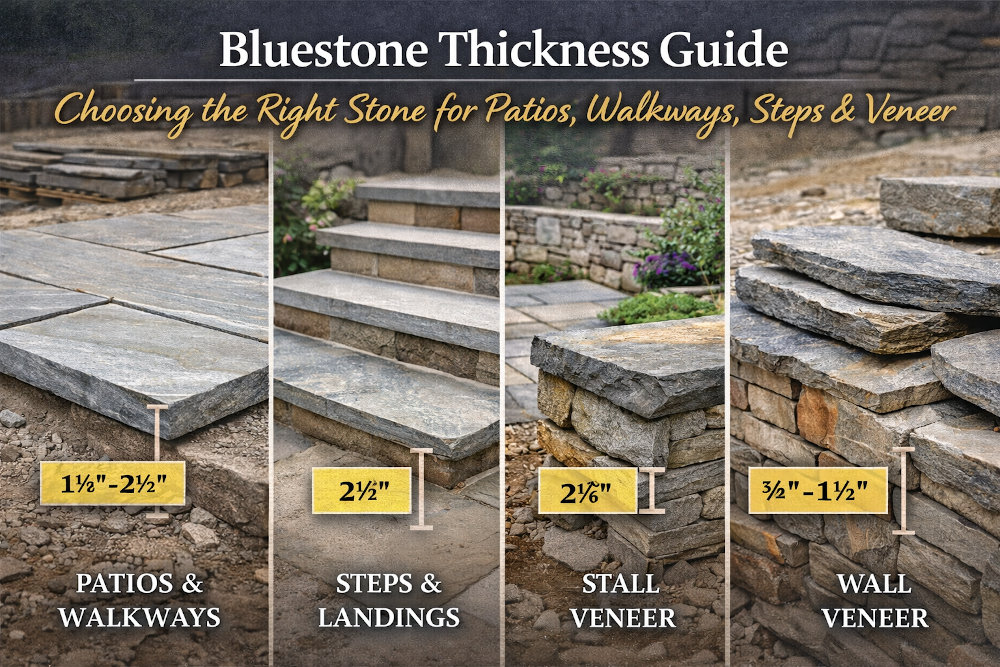
![]() Bluestone Thickness Guide: Choosing the Right Stone for Patios, Walkways, Steps & VeneerOne of the most important decisions when selecting Pennsylvania bluestone is choosing the proper thickness for your specific application. Thickness affects not only appearance, but also strength, installation method, longevity, and overall project cost. This guide explains how bluestone thickness varies by use—and how to select the right profile for patios, walkways, steps, pool decks, walls, and architectural projects. Why Bluestone Thickness MattersUnlike manufactured pavers, bluestone is a natural material that can be split or cut into a wide range of thicknesses. The correct thickness ensures:
Common Bluestone Thickness CategoriesThin Bluestone (Veneer & Wall Applications)Typical thickness: Approximately 1"–2" This profile is intended for vertical or adhered applications, not walking surfaces.
Not recommended for: patios, walkways, or any load-bearing surface. Standard Patio & Walkway BluestoneTypical thickness: Approximately 1½"–2½" This is the most common range for natural cleft flagstone and dimensional cut patios and walkways.
Installation is typically sand-set, mortar-set, or placed on a prepared base with proper drainage. Heavy-Duty Bluestone (Steps, Landings & High-Traffic Areas)Typical thickness: 2½"–4" or more Thicker bluestone is used where structural strength and edge durability are critical.
This material is commonly used in full-depth steps or as thick-cut treads supported by masonry or concrete. Natural Cleft vs Dimensional ThicknessNatural Cleft BluestoneSplit along natural stone layers, this material varies slightly in thickness and has a textured surface.
Dimensional Cut BluestonePrecision cut to consistent thickness for modern, clean-lined installations.
Thickness by Application (Quick Reference)
How Thickness Affects InstallationThe thicker the stone, the more forgiving it is structurally—but thicker stone also:
Choosing the correct thickness upfront helps avoid unnecessary cost and installation complications. Climate ConsiderationsIn freeze/thaw regions, proper thickness combined with correct base preparation and drainage is critical. Thicker stone generally performs better in high-stress environments, but even thinner stone can perform well when installed correctly. How to Choose the Right Thickness for Your ProjectTo determine the best thickness, consider:
Get Expert Guidance Before OrderingBecause bluestone is natural and project needs vary, it’s always wise to confirm thickness requirements before purchasing. The right thickness ensures safety, longevity, and a finished project that looks as good years from now as it does on installation day. Next step: Contact us with your project type and square footage, and we’ll help you select the proper Pennsylvania bluestone thickness for your application.
|